Indian cuisine consists of a wide variety of regional and traditional cuisines native to the Indian subcontinent. Given the range of diversity in soil type, climate, culture, ethnic groups, and occupations, these cuisines vary substantially from each other and use locally available spices, herbs, vegetables, and fruits. Indian food is also heavily influenced by religion, in particular Hinduism, cultural choices and traditions.The cuisine is also influenced by centuries of Islamic rule, particularly the Mughal rule. Samosas and pilafs can be regarded as examples.
Historical events such as foreign invasions, trade relations, and colonialism have played a role in introducing certain foods to this country. The Columbian discovery of the New World brought a number of new vegetables and fruit to India. A number of these such as the potato, tomatoes, chillies, peanuts, and Guava have become staples in many regions of India.Indian cuisine has shaped the history of international relations; the spice trade between India and Europe was the primary catalyst for Europe’s Age of Discovery.Spices were bought from India and traded around Europe and Asia. Indian cuisine has influenced other cuisines across the world, especially those from Europe (especially Britain), the Middle East, Southern African, East Africa, Southeast Asia, North America, Mauritius, Fiji, Oceania, and the Caribbean.
Indian cuisine reflects an 8,000-year history of various groups and cultures interacting with the Indian subcontinent, leading to diversity of flavours and regional cuisines found in modern-day India. Later, trade with British and Portuguese influence added to the already diverse Indian cuisine.
Antiquity
Early diet in India mainly consisted of legumes, vegetables, fruits, grains, dairy products, and honey. Staple foods eaten today include a variety of lentils (dal), whole-wheat flour (aṭṭa), rice, and pearl millet (bājra), which has been cultivated in the Indian subcontinent since 6200 BCE. Over time, segments of the population embraced vegetarianism during the Śramaṇa movement while an equitable climate permitted a variety of fruits, vegetables, and grains to be grown throughout the year. A food classification system that categorised any item as saatvic, raajsic, or taamsic developed in Yoga tradition.The Bhagavad Gita proscribes certain dietary practices (chapter 17, verses 8–10) Consumption of beef is taboo, due to cows being considered sacred in Hinduism. Beef is generally not eaten by Hindus in India except for Kerala, parts of southern Tamil Nadu and the north east.
Foods mentioned in ancient Indian scripture
While many ancient Indian recipes have been lost in history, one can look at ancient texts to see what was eaten in ancient and pre-historic India.
- Rice
- Rice Cake
- Curd
- Sugar
- Ghee
- Bread Fruit
- Pomegranate
- Mango
- Rose Apple
- Barley
- Mustard
- FigS
- Betel Leaves
- Honey
- Salt
- Saffron
- Sesame Oil
- Grape Wine
- Turmeric
- Sugarcane
- Chickpeas
- Sorghum
Middle Ages to the 16th centuries
During the Middle Ages, several Indian dynasties were predominant, including the Gupta dynasty. Travel to India during this time introduced new cooking methods and products to the region, including tea. India was later invaded by tribes from Central Asian cultures, which led to the emergence of Mughlai cuisine, a mix of Indian and Central Asian cuisine. Hallmarks include seasonings such as saffron. In the late 18th/early 19th century, an autobiography of a Scottish Robert Lindsay mentions a Sylheti man called Saeed Ullah cooking a curry for Lindsay’s family. This is possibly the oldest record of Indian cuisine in the United Kingdom.
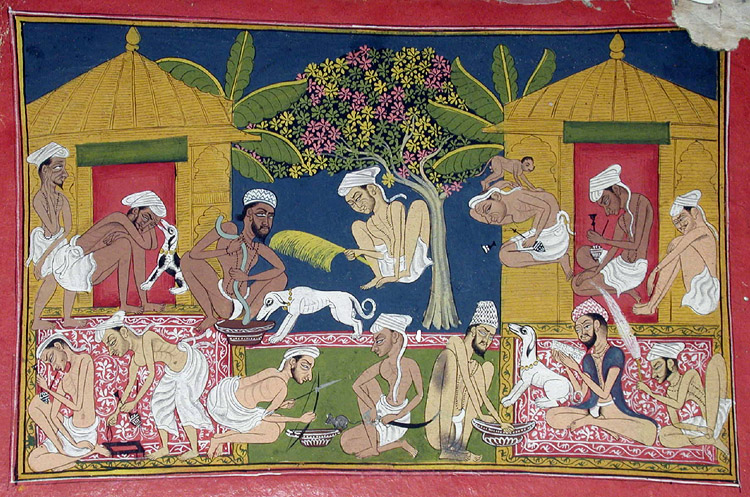
- Bhang eaters from India c. 1790. Bhang is an edible preparation of cannabis native to the Indian subcontinent. It has been used in food and drink as early as 1000 BCE by Hindus in ancient India.
NORTH INDIAN CUISINES :
ASSAM:Assamese cuisine is a mixture of different indigenous styles, with considerable regional variation and some external influences. Although it is known for its limited use of spices,Assamese cuisine has strong flavours from its use of endemic herbs, fruits, and vegetables served fresh, dried, or fermented. Rice is the staple food item and a huge variety of endemic rice varieties, including several varieties of sticky rice are a part of the cuisine in Assam. Fish, generally freshwater varieties, are widely eaten. Other nonvegetarian items include chicken, duck, squab, snails, silkworms, insects, goat, pork, venison, turtle, monitor lizard, etc. The region’s cuisine involves simple cooking processes, mostly barbecuing, steaming, or boiling. Bhuna, the gentle frying of spices before the addition of the main ingredients, generally common in Indian cooking, is absent in the cuisine of Assam. A traditional meal in Assam begins with a khar, a class of dishes named after the main ingredient and ends with a tenga, a sour dish. Homebrewed rice beer or rice wine is served before a meal. The food is usually served in bell metal utensils. Paan, the practice of chewing betel nut, generally concludes a meal.
SOUTH INDIAN CUISINE:
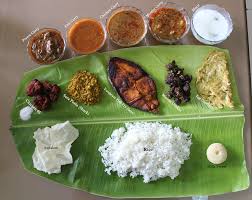
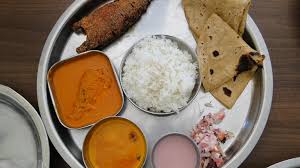
TAMIL NADU: TAMIL NADUis noted for its deep belief that serving food to others is a service to humanity, as is common in many regions of India. The region has a rich cuisine involving both traditional non-vegetarian and vegetarian dishes. Tamil food is characterised by its use of rice, legumes, and lentils, along with distinct aromas and flavours achieved by the blending of spices such as mustard,curry leaves, tamarind, coriander, ginger, garlic, chili pepper, cinnamon, clove, cardamom, cumin, nutmeg, coconut and rose water. The traditional way of eating a meal involves being seated on the floor, having the food served on a plantain leaf, and using the right hand to eat. After the meal the plantain leaf is discarded but becomes food for free-ranging cattle and goats. A meal (called Saapadu) consists of rice with other typical Tamil dishes on a plantain leaf. A typical Tamilian would eat on a plantain leaf as it is believed to give a different flavour and taste to food. Also growing in popularity are stainless steel trays – plates with a selection of different dishes in small bowls.
Dietary restrictions
In India people often follow dietary restrictions based on their religion or faith:
- Hindu communities consider beef taboo since it is believed that Hindu scriptures condemn cow slaughter. Cow slaughter has been banned in many states of India.
- Vaishnavism followers generally are strict lacto-vegetarians due to an emphasis on Ahimsa. They also do not consume garlic and onions because they are advised against it in the Bhagavad Gita.
- Jains follow a strict form of lacto-vegetarianism, known as Jain vegetarianism, which in addition to being completely lacto-vegetarian, also excludes all root vegetables such as carrots and potatoes because when the root is pulled up, organisms that live around the root also die.
- Muslims do not eat pork or pork products.
- Unlike some East asian countries, dogs and cats are not considered suitable for consumption.
Etiquette

Eating by hands
Traditionally, meals in India were eaten while seated either on the floor or on very low stools or mattress. Food is most often eaten with the hands rather than cutlery. Often roti is used to scoop curry without allowing it to touch the hand. In the wheat-producing north, a piece of roti is gripped with the thumb and middle finger and ripped off while holding the roti down with the index finger. A somewhat different method is used in the south for the dosai, the adai, and the uththappam, where the middle finger is pressed down to hold the crepe down and the forefinger and thumb used to grip and separate a small part. Traditional serving styles vary regionally throughout India.
Contact with other cultures has affected Indian dining etiquette. For example, the Anglo-Indian middle class commonly uses spoons and forks, as is traditional in Western culture.
In South India, cleaned banana leaves, which can be disposed of after meals, are used for serving food. When hot food is served on banana leaves, the leaves add distinctive aromas and taste to the food. Leaf plates are less common today, except on special occasions.
 Renu's blog
.jpg)